 ScrapBook
Item scrapbook index
ScrapBook
Item scrapbook index
U1 Roughs ................................................................. U2 Sunk Head
U3 Tongue ................................................................. U4 Knock John
U5 Nore .................................................................... U6 Red Sands
U7 Shivering Sands ............................................................................
This page is updated as new information becomes available
Issue 65: Updated : 27th November 2022
All calculations based on 1 nautical miles @ statute 1.15 miles

Map of British Defences
Background: The notion of Forts was planned by the Admiralty in WWI, a chain of eight Towers code named M-N designed by Guy Maunsell were proposed to close the Straights of Dover to German U-Boats
By 1918 at the end of WWI only one Tower and another one had been partially completed at Shoreham Harbour at a cost in excess of a million pounds
Sitting on a honeycomb concrete base, the finished 40'diameter (12.1 m) Tower sitting on an 80' base (24.3 m) the redundant Tower was towed by two paddle steamers to the Nab Rock at the entrance to the Eastern deep water approaches of the Solent to replace the lightship and sunk in 20 fathoms of water (120'/36.5 m)
The other partially built Tower being scrapped in 1924

Nab Tower
See more on the Nab Tower other Forts below
The World War II Naval Forts off the Kent, Essex & Suffolk Coastline were initially called Thames Estuary Special Defence Units No's 1-4 (TESD or TESDU's) which was changed to the the MoD code "Uncle" and subsequently given the abbreviation "U" followed by their number
More commonly these days the Forts are simply known as the Maunsell Sea Forts after their designer Guy Ansell Maunsell

Civil Engineer Guy Ansell Maunsell (1884 - 1961)
With the Luftwaffe dropping a new German Magnetic Influence Mine by parachute from Seaplanes on dissolving tallow lines, mines sank to the sea bed to be detonated when the steel mass of passing ships disturbed their magnetic field

German Magnetic Mine quite distinct from the more familiar shaped Contact Mine ships
With resulting heavy shipping losses the Germans effectively had a stranglehold on London and the Eastern Seaboard

P.S as HMS Medway Queen part of a flotilla that patrolled Dutch waters
Something had to be done to stem the losses, the Admiralty commandeered old wooden pleasure paddle steamers, these were painted battleship gray, fitted with a 40mm Bofors Gun to patrol the waters of the Thames Estuary, the Eastern Seaboard, North Sea coast and waters off Europe

Eric Woodroffe at the gun on HMS 'Medway Queen' (Whitstable Times)
But a more permanent deterrent was needed to protect what was then the busiest shipping lane in the World. Originally there were to be 3 Martello style Forts placed strategically at 6 mile intervals across the Thames Estuary between Margate and Clacton
This was reduced to 4 Forts & after much consultation and amended criteria, Guy Maunsell came up with a new Naval Fort design for the Admiralty manned by Marines and Blue Jackets
To meet the special needs of the Admiralty and War Office 1: Break up enemy aircraft formations. 2: Prevent laying of mines and E'boat shipping raids in coastal waters. 3: Act as early warning outposts of hostile aircraft and release patrol vessels for other duties
Preparation surveys of the seabed were conducted to find flat level sites on 'earmarked' sandbanks. Grounding would be made during calm fair weather, with an infill of 500 tons of brick rubble and chalk dumped around the Fort to prevent erosion and under scouring
See the Tugs that towed out The Thames Estuary Sea Forts
The Naval Forts

Naval Fort Elevation
These were the first design/construction: Their 24' diameter legs were built on a hollow 14' deep pontoons, at 4500 tons these monsters raised 110' from the sea-bed to the top of the radar to house, deck level was 75' above the sea-bed having an estimated weight of 4,500 tons
Exposed at sea the Forts would be open to attack by the enemy but Maunsell stated that the Naval Forts would, failing being struck by a ship or other object last 200 years

A short film on the history design, building of the Thames Estuary Naval and Army Forts, Mullbury Harbour and Floating Docks
The Naval Fort design was the basis for the Mulberry Harbours. Sinking large reinforced concrete structures onto an unprepared seabed hadn't been tried before. Examples of the Mulberry Harbour can be seen in Portland Harbour in Dorset & the remains of one off Southend-on-Sea, Essex
With an impressive build, fitting out and commissioning turn round of just 53 days the Naval Forts were towed out and grounded in around 40' of water with a tide range of approximately 20'
The 1st Fort took around 20 seconds to sink and a just 30 seconds to settle
The Forts were the first line of defence for spotting enemy aircraft, submarines and ships, with then state of the art radar prediction equipment
The Naval Forts were armed with two Vickers-Armstrong 3.7" static MK2c Heavy Anti-Aircraft Guns at each end of the 110’ x 32’ deck. Woolwich Arsenal issued the specification in 1933, two designs were submitted in 1934, a trial gun was made & approved in 1936, the first production model delivered in 1938. They fired a 28lb shell @ 2,600 ft per second, had a maximum range of 20,600 yards horizontal & a velocity ceiling of 41,000 ft. By hand they could achieve 10, or by automatic loader 25 rounds per minute. The Forts also had two light 40mm Bofors Anti-Aircraft Guns; With a total weight 4368 lbs they had a barrel bore length of 7'38" With a 360 deg traverse & recoil of 8" they fired a 2lb shell at 2,700 ft per sec. Range was 10,800 yd's with a ceiling of 23,600 ft. The effective range & ceiling sought 5000 ft at 120 rounds per minute, Lewis Guns were also available. * Each Fort was Manned by 120 men: 90 Marines, 30 Sailors, 3 officers. The Officers living at deck level & the men on 4 of the 7 lower decks
* There are differing reports on manning initially said to be 100 men, 96 ratings, 3 Officers and 1 NCO
The Naval Forts never, as some believe had proper Air Conditioning, but the air was heated in cold weather by oil fired boiler within the main deck, known as the 'Bridge' and circulated by a huge electric Boxer style fan throughout the Fort
The deckhouse contained the CO’s (Commanding Officers) cabin, a cabin for three other officers, washrooms, and toilets and on the outside a meat and bread locker
The deck above had two Bofors Guns, with sponsons (wings), which had direction and height predictors for the AA Guns. A 27’ Whaler & Sea Motor Boat were slung below the wings. Hastily made V shaped steel framed and wooden decked ‘Dolphins’ were fitted to each Naval Fort to aide tendering
Two centrally place tanks contained 5,000 gallons of fresh and 1,600 gallons of salt water. Electric hoists conveyed ammunition from the magazines, to the open-ended main deck
The deck above housed the Control Room, which had plotting table, voice pipes and telephones for communication with the guns, sister Forts* and shore. Radio transceivers and control panel for the Type 273 Radar Dishes and S.L.C radar antennas above. Outside two Bofors predictors with four Lewis Guns later removed and replaced with Twin Browning .303 Guns
Manned by Royal Marines under Naval RNVR Officers. Naval Sergeants, Corporals and Ranks basic trained at various UK Naval Schools
Conditions for the ratings on the Naval Forts wasn't so good with crew, forced to spend long periods below Naval Crews were persuaded to take up hobbies: Painting and Drawing, Model Making, Tapestry, Knitting and Scrimshaw work. Knock John Fort (U1) had a piano which had been dismantled, manhandled below and reassembled all to help stay off the dreaded"Fort Madness" a condition diagnosed by medics in the latter part of the war

Naval Fort Model
North Leg
7. (G) Lowest deck Oil and Fuel & sump
6. (F) Navel Store and Magazine with fire flooding facility
5. (E) Accommodation for 12 men, with 6 double bunks, tables, benches, mess racks and cupboards. Drainage & pumping sea water at this level was accomplished by a 3” pipe
4.(D) 3.(C) 2. (B) Accommodation as 5 (E)
1.(A) Engine room with 2 x Gardner 30kVa generators, switchboard and workbench, the second generator being a stand-by unit
South Leg
Followed a similar the same pattern to the North Leg with following differences:
7. (M) (G) 500 gallon fresh water tank and an electric L.E.C refrigerator
6. (L) (F) Provision store, Magazine with fire flooding facility
1. (H) (A) Reserve 30kVa Gardner generator, switching, workbench and canteen
Navy ratings had 6 weeks turn of duty with 10 days leave, and 3 days at shore base
The Roughs U1 & Sunk Head U2 crews off Essex were billeted at HMS Badger in Nissen Huts in railway sidings at Parkestone Quay, Harwich, Essex
‘HMS Wildfire’ Naval crews from Tongue U3 and Knock John U4 were accommodated at Sheerness Docks in former Napoleonic buildings

The Tug 'Sun X' passing a Thames Naval Fort in Thames Tugs
Cartoon Postcard by Artist Pelham Jones 1946
The 196 gross ton 'Sun X' was built by Cochrane & Sons, Selby Yard in 1920 IMO 5344322
The Army Forts
The Army also wanted Forts to hamper bombing raids by breaking up aircraft formations
In the North of England, Liverpool Docks was a prime target whilst in the South East the Thames Estuary aided navigation to London and docklands

Army Fort Plan
Initial model trials were conducted off Southend Pier and samples taken of the seabed in Mersey Bay resulting in a completely new Fort design
The Mersey Bay off Liverpool were to get 3 sets of Heavy Anti-Aircraft (AA) Army Forts constructed by the Cleeveden Bridge and Engineering Company Limited

War Office Army Fort Construction Plan
The specification the Army Forts comprised 7 Towers each weighing an estimated 580 tons: Control (Command) Bofors, Searchlight and 4 x 3.7" Gun Towers spaced at around 100 feet apart in a similar formation to a shore Anti-Aircraft Battery linked by telescopic catwalks

Elevation of a 3.7 inch Army Fort Gun Tower
Legend: (a) Steel House (b) Pre-cast hollow reinforced legs section (c) In-situ reinforced concrete leg joint (d) Steel bracing section (e) Fenders (f) Hollow reinforced concrete base (g) Lifting hooks (h) High water (i) Low water


Mersey Fort Construction Site Bromborough Docks (1942) (IWM)
Slung between a pair of Barges the Army Forts were lowered rather than sunk in position which took up to eight hours to accomplish
The Bofors Tower was sited first to offer protection as the following Towers were completed, taken out and lowered

The 1st of the Mersey Towers Fort #3
The Bofors Tower being lowered between Camel Barges (7th October 1942)

The Bofors Tower at Mersey Fort #3 grounded (7th October 1942)
Sunk at slack tide in around 30' of water they rose 35.7 metres (117') from the sea-bed to their top. Wartime personnel access was normally by ladder, the first climb of 10'onto the landing stage, 25' to the second stage level and a further 25' into the Fort

A Gun Tower placed at Mersey Fort #3 (November 1942)

Five Towers of Mersey Fort #3 in place (January 1943)

Mersey Fort #3, note the tilt of Gun Tower #3
Proposals to correct the tilt apparent on a number of the Mersey Towers by lifting with hydraulics& in filling with brick rubble 'bit bats' wasn't adopted
Mersey Fort construction period: 7th October 1942 - 25th July 1943
Fort #3 53 30' 22" N 3 17' 10" W 7th October 1942 - week commencing 15th February 1943
Fort #2 53 32' 30" N 3 17' 30" W January 1943 - April 1943
Fort #1 53 34' 30" N 3 12' 54" W April 1943 - 25th July 1943
The Mersey Fort Contract AD 50054 dated 2nd December 1941 issued to the Cleveland Bridge & Engineering Company Limited was signed off by The Admiralty on 20th August 1944
The three Mersey Forts 3, 2 and 1 off Liverpool Bay, came under control of No 33 Anti-Aircraft Brigade, 4 AA Group
The first Mersey Fort No 3 was taken over by No 637 Independent HAA Battery, within 28 Brigade, 2 AA Group formed on 26th February 1943 to operate the three Mersey Forts
In March 1943 lack of activity dictated the transfer of the unit to the imminently ready Thames Forts on 10th March 1943 to their new HQ at the Drill Hall, Springfield Road, Northfleet, Kent transferring to The Drill Hall, Watling Street, Gillingham, Kent on 23rd June 1943 responsible for U6 Red and U7 Shivering Sands. On 23rd July 1943 they were formed into No 1 Anti-Aircraft Fort Regiment RA
Meanwhile 585 HAA Battery was assigned to take on the Mersey Forts manning just the Bofors & Searchlights

War Office Fort Army Plan showing Thames Estuary Gun Tower numbering
N.B Numbering of the Liverpool Bay Mersey Fort Gun Towers believed to be Counter-Clockwise
Bofors Towers; also the Galley/Mess Tower were positioned first defending the site as the other 6 Towers followed to be lowered into placed. The Bofors and Searchlight Towers as had four steel tanks slung beneath the lower level floor containing 500 gallons of fuel 2000 gallons for each complex. The Gun and Control Towers had a 2,000 gallon fresh and 1,000 gallons salt-water tank. ‘Crittal’ made the windows fitted with ‘black-out’ Shutters and Louvre's. Solid fuel boilers provided hot water and warmed the radiators throughout each Tower. Again three 30 kVa Gardner Generators plus an extra 11 kVa set to supply the complex crane hoists, guns, searchlights, signaling, radio and radar, Trinity House navigation signals, domestic and refrigeration equipment were on the Searchlight Tower
An 14’ open ‘clinker’ wooden motor lifeboat was slung beneath the Control Tower provisioned with three months reserves. Carley floats and life buoys were distributed around the complex

Army Gun Tower showing Liferaft slung from the side
Proposals to construct Forts off the Humber, Portsmouth, Rosyth, Belfast and Londonderry never materialized
In the difficult ever shifting seabed conditions of the Mersey Estuary, the Liverpool Bay Forts were demolished soon after the war
The Army Forts were fitted with four later model MK6 3.7" Heavy Anti-Aircraft Guns manned by an NCO and five men. Automated firing of up to 30 rounds a minute was achieved via the Control Tower. Each complex had two 40mm Bofors Guns
Royal Engineers, Royal Signals, Medical Corps, Army Catering and Naval Units for challenging vessels entering Fort zones by Aldis Lamp all served aboard the Forts
* A full compliment being 4 Officers, 9 Sergeants and 121 Ranks (134) This increased at the height of the war to 6 Officers, 11 Sergeants and 185 Ranks (202) but it's believed that at one stage a compliment of 265 occupied Shivering Sands
Army Crews spent a month at sea then two weeks ashore
* Manning varied with reports of compliments being 120 and 165 at various stages
Conditions were comfortable with plenty of light, oil fired central heating, daily hot salt water baths and excellent food and prepared in the Control Tower Cook House
Air Spotters (Lookouts) scurried down the ladders to retrieve flotsam, for hobbyists. Old rope was spliced coloured & made into slippers, wood most sought after was made into model boats in the Royal Engineers Workshop
In fair weather daily supply ships were common bringing supplies of ammunition, diesel fuel, freshwater, mail and stores in poor conditions tendering was a when possible a minimum of once a week

Where are the Thames Estuary Sea Forts?

Thames Estuary Army Sea Forts in Action

Locations of the Thames Estuary Naval & Army Sea Forts

Fort Plans with perspective from the North Kent (UK) Coast
Bottom is South to top North - Legend: (a) Control Tower (b) Bofors Gun Tower (c) Searchlight Tower (d) Tubular Steel Bridges (e) 3.7 inch Gun Towers
All of the Forts were were were all built of reinforced concrete and steel aligned in a North-South direction
The Thames Forts were supplied by R.A.S.C. Water Transport Company, Sheerness
The Thames Estuary Naval and Army Forts were all constructed at Red Lion Wharf on the lower reaches of the Thames at Gravesend in Kent, by Holloway Brothers (London) Ltd using semi-skilled labour
Linked to one another and Fort Luton by telephone
The project was overseen by appointed resident engineer John A Posford, who became a partner in the Maunsell Company on 6th April 1944 as reward for his diligent work on the project
Narrated by John A Posford of the Civil Engineering firm Posford-Duvivier, Partner of Guy Maunsell who concieved and designed the Sea Forts, predecessor of the Mulberry Harbour and Floating Docks
N.B The film states the Guns were removed from the Navy Forts and Army Forts were demolished after the war
The Army Forts Guns were removed, it wasn't until 1992 the remaining guns on Knock John and Tongue were taken off
The Liverpool Bay Army Forts were demolished, but only Nore Sands Fort in the Thames Estuary was removed later in 1959-60


Sarasota Herald Tribune (2nd October 1944) |
Evening Independent (2nd October 1944) |
Spokane Daily Chronical (3rd October 1944) |
A German E-Boat operating out of Ijmuilden Holland was also claimed by Tongue Fort

Sarasota Herald Tribune (2nd October 1944)


Telegraph Ori (14th October 1944) |
Maple Leaf (12th February 1945) |
Video Clip: The Forts (1944)
Following May 3rd V.E Day Celebrations, on the 14th June 1945 soon after the declaration of the end of the war, the Forts were decommissioned and placed on care and maintenance
Video Clip: The Army Forts in 1948
Serviced by the Motor Fishing Vessel MFV 1037 of Harwich attached to HMS Wildfire, crews aided by civilians spent 4 weeks aboard before being relieved & spending between 7-14 days ashore. The Naval Towers were considered briefly for use by Trinity House for Lighthouses but this came to nothing. In 1956 the Ministry decided the Forts were of no further use, but continued to man the Forts for another two years with caretaker crews, they were to finally leave all the Forts and Towers by 1958 abandoning them to their own fate and the elements
Deserted before the Pirates rediscovered them in 1964 the Forts were scavenged for scrap metal and useful items by fishermen and others
The Naval Towers in particular were targeted for their brass portholes and fittings
The Army Forts had their Guns, Searchlights, Radar and other military paraphernalia removed by the MoD
The Naval Forts had their Bofors Guns and Radar removed, but for some unknown reason, perhaps their older vintage, their 3.7" Guns were left behind, minus their breech blocks
In July 1992 a team of RAF and Royal Engineers from Chatham in a Chinook helicopter removed the 3.7" Guns from Knock John and Tongue Sands, one went to New Tavern Fort Gardens at Gravesend the rest to a museum in Scapa Flow. Ray Hughes, formerly of Herne Bay had proposed a training scheme in which he'd get the guns without cost for display, as Scapa Flow's own had long gone
A good many people have the romantic notion that the Radio Pirates left the Forts like a deserted house
That's not the case, virtually everything has been removed from the Forts
In the 1990's the Forts were used for a period by the SAS for simulated oil rig assault training
The Army Forts were provided principle designs for Oil Sea Drilling Rigs
The Sea Forts U1 - U7 in Detail

Approaching Fort 1: U1 (Uncle) Roughs Naval Tower

Fort 1: U1 (Uncle) Roughs Naval Tower

Fort 1: U1 (Uncle) Roughs Naval Tower officers & ratings on Dolphin

Roughs Naval Tower as Sealand (1968)
Roughs Naval Fort "U1" pictured in 2000 grounded at 51 53'.40.8" N & 1 28.'56.7" E with telephone link to Languard Fort G.O.R, Harwich Naval Plot and Sunk Head Fort
WGS 84 Chart Checks 1st March 2006: 51 53.71 N & 1 28.83' E Enduring snow and high winds towing the 100-foot high 4,500 ton mass the tugs had problems controlling the unwieldy fort. It hit a number of buoys the Thames Boom in place between Minster (Sheerness) on the Isle-of-Sheppey to Shoebury Essex. Roughs was the first Fort to be grounded on Wednesday 11th February 1942 and was sunk in 37 feet of water in just 15 minutes on the Roughs Sand, some 6.0 nautical (6.9) miles off the Felixstowe, Suffolk coast. In 1944 the compliment of men was reduced as the war turned in favour of the allies, a floor was converted into a library, recreation room. Decommissioned on 14th February 1945 Knock John was reduced to care and maintenance until 1956
Post war interest was shown in the Roughs as early as 1965, when on 11th August Jack Moore and his daughter Jane were onboard. They were acting on behalf of Radio Caroline who were said to have had potential investment from George Harrison and Mick Jagger amongst others, in a failed project to turn the Fort into a fun palace and health complex. Something of a cover for an enterprise that was almost certainly broadcast related. The top house of the Fort had been cut away making a helicopter landing platform. Left for a period Roy Bates claimed the Roughs in December 1966, having closed down Radio Essex he'd decamped from Knock John some 24 nautical (27.6) miles away, a battle ensued over the occupancy of Roughs. Unattended briefly a boarding party from Radio Caroline grabbed the Fort back, they were forcefully removed by Roy Bates & his crew. With anti-pirate legislation going through Parliament, it's quite likely the Fort was taken in favour of continuing to use the Mi-Amigo, even then she was 45 years old or at least a potential supply dump for servicing both the Caroline South ship off Essex and North ship the MV Caroline off the Isle-of-Man. On the night of 27th June 1967 Caroline dispatched a team of raiders on the Offshore II from Harwich to get Bates off. The stakes were high, the Marine Etc Broadcasting Offences Act would become law on 14th August 1967, as one man tried to board petrol bombs & missiles rained down & he was left clinging to the ladder as the Offshore II pulled away. Walton-on-Naze lifeboat went out and after negotiations rescued the man. Police intervened but no charges were brought. Later in a helicopter raid by foreign investors Prince Michael was locked in his own Goal. Eventually released he was put ashore but returned mob handed to reclaim the Fort back. The squabble over ownership resulted in a German being held captive on Roughs. Exercising squatters rights and with the passing of time ownership, the Bates family have kept the Fort which is occupied to this day
Video Clip: Sealand in 1969
On the 2nd September 1976 Roughs was declared the Independent Principality of Sealand, today in many quarters is legally recognised as a the Worlds smallest Country. The idea to declare their Fort a Country was first muted by Dick Palmer to Roy Bates on a return trip from Knock John in the spring of 1966. Cutting it fine they'd left the Fort on a ebbing tide and gone aground on the middle sands close in view of the Red Sands Fort. Nothing more was thought about the passing comment until 1967
In the 1980's an American contingent invested in Sealand with an electronic haven: Haven Co. No one wanted the two 3.7" Heavy Anti-Aircraft Guns so sadly in a mass clear-out were Unceremoniously tipped over the side
Other than one turntable removed earlier, all of the Radio Essex gear was also thrown overboard
A single transmitter output valve, and some paperwork left behind on Knock John to be saved in 1969, that's are all that physically survives of the brave little station
Navigate from ScrapBook Index for all our features on Radio Essex
Whilst no Radio station has ever actually broadcast from Roughs, they might. Plans have included a Television Relay, a Top 40 Station which was close to launch in the 1980's, in 2006 a Transmitter, Generator and telescopic Versa Tower along with Studio equipment was purchased to set up two FM stations on Roughs, but unsurprisingly Sealand declined to house the proposed radio services
Whilst occupied to this day Roughs isn't wholly representative of how a Naval Fort looked when built, having had its Radar Top House & Control Tower removed in the 60's
On 23rd June 2006 thick black smoke was seen rising from Roughs Sealand on Fire A deck sited generator had caught fire which caused major damage to the Fort
9th January 2007 - Sealand Press Release, with Michael Bates on Regional BBC Anglia Television, announces Sealand are seeking investment, figures of up to a £10 million are floated
Navigate from ScrapBook Index for all the stories on the Principality of Sealand and plans of the Naval Forts
Take a look around & inside the whole of Roughs on our VCD Sealand the Grand Tour
Hear from Prince Michael of Sealand in the Sealand Adventure in our documentary

Fort 2 U2: Sunk Head Fort (1967)
Sunk Head Naval Fort "U2" was grounded at 51 46'.51" N & 1 30'.21" E for reasons unknown is sometimes referred to as Churchill One, others quote position as 51 46' 29" N 1 30' 26" E with telephone link to Languard Fort G.O.R, Harwich Naval Plot & Roughs
WGS 84 Chart Checks 1st March 2006: 51 46.63' N and 1 30.5' E at 9.74 nautical (11.2) miles from the nearest land at Frinton Essex, The Second Naval Fort was partly built by 26th March 1942 but delayed as the Admiralty were considering alternative Radar, this idea was dropped. After through bad weather the Fort was grounded at the maximum MLW (Mean Low Water) depth of 43 ft on 1st June, and was ready for action on 3rd June 1942. A distance out but close to the shipping lanes in June 1944 a violent storm took away the already damaged landing stage. Decommissioned on 14th June 1945, reduced to care and maintenance until 1956; Trinity House considered taking over this Fort to mark the outer end of the Sunk Head Sands at the Barrow Channel. Mr J P Bowen of Trinity House had been on Tongue Fort when it was positioned, having surveyed both Tongue and the Sunk Forts he recommended that Trinity House only be prepared to take responsibility from the Admiralty as Lighthouses and nothing more. He sighted NAB Tower sunk in 1918 as a concern, this Tower had listed some 4 degrees and the worry was that any settling would upset the delicate lights, so the idea didn't come to fruition
The Fort was flooded in both legs to tide level with rising and falling tides, since each the legs is in dependant, it's thought that the sea-cocks had been open when abandoned by the MoD, it might be that some ammunition had been left below but unlikely
It's rumored that the Fort had been hit by an unnamed ship in the mid-1950's but we've been unable to substantiate this
Sunk though was used by Tower Radio/Radio Tower (see our feature) and a rumored Tower TV Channel for 7 months between October 1965 - April 1966. Started by a Colchester TV dealer Radio Tower never launched properly, but weak tests were heard on various frequencies settling on 236 mmw up until 28th April 1966 . The much hyped TV broadcasts never materialised, out of money the team abandoned the Sunk Head leaving a virtually new generator and all the broadcast equipment behind
The Fort though was re-inhabited for a period by squatters C Payne of Bexley Kent and D Stoneham of London they'd no connection with broadcasting. They'd been on-board until their supplies were exhausted, lighting a fire seen by Walton & Frinton Lifeboat they were rescued on 9th November 1966
For the Sunk Head Radio Tower TV Story and pictures navigate from ScrapBook Index
Clearly well outside territorial waters and with no sand banks to bring it within UK jurisdiction, the Government were worried it might be taken over again. For a time there were stories circulating the Fort was being used for smuggling. Boarded on Friday 18th August 1967 by a contingent of the 24th Field Squadron of Royal Engineers from Maidstone from the Chatham Tug Collie, under the command of Major David Ives, the Fort was weakened by acetylene cutting torches. 3200 lbs of PE 4 plastic explosives were set, and on 21st August 1967 at just after 16.00 hours Sunk Head was blown up to prevent further use, and perhaps deter those on Roughs from becoming too complacent
The shock waves were felt in Harwich and the detonation noise carried over 12 miles, just a 20 feet of the leg stumps remain
Video Clip: Sunk Head Destroyed
An undated collision occurred when an unnamed liquid gas carrier crashed into the leg remains resulting in significant hull damage

Fort 3 U3: Tongue Naval Fort (1992)
Tongue Naval Fort "U3" pictured above just after it was said to have been sealed by welding* and the 3.7" guns pulled by RAF Manston in June 1992
* Evidence does not support sealing
Grounded on 27th June 1942 at 51 29'55" N & 1 22'.11" E also quoted as 51 29' 5" N 1' 22. 0" E with telephone link to Fort Luton G.O.R, Chatham Plot & Knock John
WGS 84 Chart Checks 1st March 2006: 51 29.57' N and 1 22.0 E some 5.5 nautical (6.32) miles off Margate. There are two versions of this story; On the night of 22nd/23rd January 1945 fifteen German E-Boats were seen on Radar, five close by, the S.119 or S.199 operating out of Ijmuilden, Holland was just over 4 miles away, coming under heavy fire from Tongue's 3.7" guns, unsure of from where the shelling came, the Captain maneuvered to avoid being hit and rammed another E-Boat, badly damaged he scuttled his vessel. Version two is that a plum of smoke and flames were seen by the deck observers on Tongue and reports that casualties were picked up and the E-Boat destroyed. Tongue was decommissioned on 14th February 1945 and reduced to care and maintenance. This Fort had settled badly and as a result became under scoured and unstable. On the 5th December 1947 the Fort shook violently and parts began falling into the sea. The caretaker crew put out a distress call and were rescued by HMS 'Uplifter'. Divers later investigated and found the foundations solid, but in a storm shortly after the Fort rocked and took on a 15 degree list. The Margate Lifeboat evacuated 4 remaining men who were understandably eager to abandon
Caretaker crews were to return, but the Fort was finally abandoned in 1949 after its pontoon broke its back flooding the lower levels
Stripped of Bofors Guns & Radar however, much of the Forts paperwork and other items were left behind to appear later
Like Sunk Head Fort Tongue was briefly considered for use as a Lighthouse by Trinity House, but instead a lightship was moored close by until Trinity House began its programme of withdrawal in the mid-1980's
No Offshore Radio ever broadcast from Tongue, though Radio Essex from Knock John some 8 nautical (9.2) miles away considered using the Fort, they boarded in the summer of 1966 retrieving scrap to sell. By then under-scouring had further distorted the Fort. The ceiling of level (A) the generator room had partially collapsed and large holes had appeared in East leg which were big enough to crawl through. Sea water had flooded the lower levels and the platform had become detached with huge gaps between the deck
The Radio Essex team attracted attention, burning insulation from copper and lead plums of black smoke raised a call to the Coast Guard who alerted RAF Manston
A Search & Rescue Helicopter was dispatched and circled the Fort, so after the Margate Lifeboat arrived and hailed the Fort. When confronted a quick thinking Dick Palmer shouted "We're a new radio station" and produced the name Radio Albatross promoting questions in the House of Commons about the arrival of more Radio Pirates. Amusingly, even though broke Roy Bates made noises in return saying he'd begin new stations Radio Kent & Radio Eros from the Knock John
Radio Essex scavenged metal benches, scrap metal and the ammunition hoist motor,which survives, firstly taken to Knock John then to Roughs in 1966
In June 1992 the 3.7" guns were pulled by Chinook Helicopters from RAF Manston. One of Tongues 3.7" Guns can be seen in the New Tavern Fort Gardens, Gravesend, the other joined the two from Knock John at Scapa Flow

Thames Naval Fort 3.7 Heavy-Anti-Aircraft Gun at the Scapa Flow Museum & Visitor Cente at Lyness Naval Base
The 3.7" Guns have been transported from the remote Lyness Naval Base Dumfries Aviation Museum, see Medway & Thames Defences
Tongue Forts damaged leg continued to distort and resulted in the collapse and loss of the whole Fort into the under scouring hole during overnight storms on February 21st & 22nd 1996, all that remains is a single 18 foot stump of the South leg
You can see Tongue Fort pictured during the mid-1980's with its heavily distorted leg in Caroline 83 & Eurosiege
A concise history of the Fort from 1942-1996 can be seen in Tongue Tower
You can read & hear more about the exploits of Radio Essex in our Radio Essex Gift Pack
Our DVD Sealand Grand Tour gives an in depth view of life on & inside a Naval Fort

Fort 4 U4: Knock John (2003)
Knock John Naval Fort "U4" 51 33'.72" N 1 09'.83" E is 4 nautical (4.6) miles from Shivering Sands Fort also given as 51 33’ .40” N 1 09’ 45” E with telephone link to Fort Luton G.O.R, Chatham Plot and Tongue
Pictured above just after it was said to have been sealed by welding* and the 3.7" again had her guns pulled by RAF Manston in June 1992
* Evidence does not support sealing
WGS 84 Chart Checks 1st March 2006: 51 33.74' N & 1 9.71' E grounded on 1st August 1942 around 8.75 nautical (10.06) miles from Foulness Island the nearest Essex coastline, and 16 nautical (18.41) miles from Southend its later Pirate Radio Station base. It was decommissioned on 14th June and evacuated on 25th June 1945 and reduced to care and maintenance until May 1956
Whilst negotiating the sale of the Radio City operation on Shivering Sands, to either Radio Caroline as a relay, and when that deal faltered to Radio London for the UKGM (United Kingdom Good Music) Station. Radio City planned to use the Knock John Fort for another radio station, they'd pressed ahead sending a small team to Knock John taking with them the redundant 188 metre Cossor Transmitter, a small Lister Generator and various other bits of broadcasting equipment. Radio Essex also had designs for the Fort, the net result was that respective crews were regularly deported off and on the Fort before an uneasy truce was reached. Radio Essex finally took full control and commenced testing on 27th October 1965 until 25th December 1966. Leaving on Christmas Day they took everything, and some parts they'd salvaged from Tongue Fort and Shivering Sands, 4 and 5 nautical miles away respectively, and set off for the Roughs 20 nautical (23.01) miles away off Felixstowe
Hear the whole story of the Radio City boarding in our documentary CD Radio City 2
For the story of Radio Essex see our Radio Essex Gift Pack
Navigate from ScrapBook Index for all our features on Knock John & Radio Essex

Knock John less 3.7" Guns (June 1992)
In June 1992 the 3.7" guns were pulled by Chinook Helicopters from RAF Manston for onward transportation to Scapa Flow

Map showing the Scapa Flow Visitor Centre Centre & Museum
A few minutes walk from the Lyness Ferry Terminal the museum is at the old Naval Lyness Fuel Pumping Station (HMS Proserpine) illustrates the importance of Scapa Flow in WWI & WWII
Scapa Flow Visitor Centre and Museum, Lyness, Hoy, Orkney, KW16 3NU (01856 791300)
10/09/09 - I am enquiring about the Knock John fort. I want to do a Facebook group for this fort and would like to let people know about the group. One question I have is in regards to it condition. I have read that it's pontoon has broke and that it's leg is leaning. I have not noticed this in any photo's. Can you enlighten me? I would like to raise awareness of this fort as it's the only one left, Sealand has been converted too much. I would be great if it could be preserved in some way along with Redsands. Regards, Mark Pedder
2009 - We have been out to the Knock John a number of times & notice a slight distortion of the legs when viewing the Tower from West to East. However, there is no evidence to support statements that the pontoon has broken its back. It's likely that under scouring is the cause of the discernable condition but even this could only be confirmed by underwater survey - Ed

The Great Nore Bofors Tower
Nore Army Fort "U5" said to be at 51 25'.45" N & 0 50'00" E
WGS 84 Chart Checks on 16th March 2009: Converting co-ordinates from a 1940's Admiralty Chart (extract above) places the Great Nore Tower at 51 29.2' N & 0 52.2' E at the head of the Yantlet Channel before the now Sea Reach #1. The Nore Bofors Tower was the first of the Fort complex floated out on 20th May, lowered in 35 feet of water. All 7 Towers were sited by 3rd July 1943

Admiralty Chart showing Nore Army Forts (1943)
The Fort set positioned at approximately 3.2 nautical (3.68) miles from from the nearest land at a point between Shoebury and Havengore Creek. After hostilities ceased in May 1945 the Anti-Aircraft Regiment, Royal Artillery left in September and the Anti-Aircraft Fort Maintenance Detachment took over Nore until 1956. In 1948 the MoD had visited the Fort when considering a new design of Heavy Anti-Aircraft Fort comprising 9 Towers, by 1953 this proposal was deferred through cost

Glasgow Herald (3rd March 1953)
On 1st March 1953 a Swedish pulp carrier the 'Baalbek' ran into the Bofors and G4 Gun Tower killing 4 civilian crew, 6 other caretakers were taken ashore. Throughout the rest of 1953 ideas to continue using Nore as a defensive Fort in part by the PLO were muted

'Baalbek' moored off Garisson Point, showing catwalk remains across her bows (3rd March 1953)

Fort 5 U5: The Nore Searchlight Tower & submerged G2 (1954)
In late 1954 there was another collision when the 'Mairoula' crashed into the Fort and knocked over Gun Tower 2 and damaged one of the Searchlight Towers reinforced concrete legs which was repaired
In 1955 with the Fort at the head of one of one of the Countries busiest shipping lanes, the War Office couldn't shun responsibility and decided that with no operational use the Nore Fort complex should be completely removed. In 1956 Armaments, Searchlights and Radar was lifted by floating crane barge and taken to Chatham Dockyard. The Fog Horn and remaining lighting was taken off in 1957
On 30th January 1958 with the Great Nore the only Fort within then UK Territorial Waters was deemed a hazard to shipping in the Thames approaches and was dismantled between 1959 - 1960 The top house's were bought for scrap by Matthew Lynch & Son Ltd on the River Medway

Nore Fort bases at Cliffe (1992)
The reinforced concrete legs were blown off, their bases towed ashore and discarded at Alpha Wharf near Cliffe Fort in Kent, pictured above in 1992. The rest of the debris was spread around the Nore Sand and traces of which can be seen on echo sounder
See our feature on the Great Nore Fort

Fort 6 U6: Red Sands Forts (1965)
Red Sands Army Fort "U6" second set of the Army Forts at 51 28'06" N and 0 59'06" E pictured above in June 1965
WGS 84 Chart Checks 1st March 2006: 51 28.6' N and 0 59.4' E at 5 nautical (5.75) miles from nearest land at Warden Point Isle-of-Sheppey, and 7 nautical (8.05) miles from Whitstable the Forts were floated out between July and November 1943
Video Clip: Red Sands in 1943
11/3/11 - Charles Wolfe (aged 76 - G6HRY) of Bury St Edmunds spent a memorable short spell on the Red Sands Forts 'I was with 2nd Para, Colchester. We were sent out on an exercise, once alongside we scrambled up the landing stage then hauled our 25lb gun up in sections. The wind was howling, it rained then a proper storm broke with thunderclaps & lightning. Spent a week or so there, what dismal place. I was happy to get back to dry land'
Like the Great Nore it's equipment was removed & a short time to serve care and maintenance crew staying until 1956, the MoD finally decided to abandon the Forts in 1958
In 1959 consideration was given to re floating the Red Sands Forts and bringing them ashore, but the costs were cost prohibitive
Radio Invicta boarded and began testing from 3rd June 1964, following the tragic death of their owner Tom Pepper (Harry Featherbee) Radio Invicta became Radio K.I.N.G in March 1965 up until 22nd September 1965, initially identifying as coming from the Nore!? (Clearly Lost Pirates) K.I.N.G's format & poor signal due to a bad antenna, failed to attract an audience. After considerable re-investment and the building of a new antenna mast, said to have been 297' in fact it comprised 15 x 10' sections (150') placed on top of 117' from sea bed Tower. In reality the mast could have been claimed to be 267' high but allowing 30' for mean tides was more like 237' high. The new station Radio 390 opened on 23rd September 1965. In 1966 a TV production crew went aboard Red Sands Fort along with lead actor Patrick McGoohan to partly film an episode of 'Danger Man' Patrick in as 'John Drake' was film running across the catwalks for scene setting and incidental footage

Middle Sand
The Middle Sands (Beacon) is less than 3 miles from the low water shoreline and less than 2 nautical miles from Red Sands Forts. Shown above dry(ish) with Naval Officer Commander Mackay it was the 'proof' needed by the Government to bring the Red Sands Forts within the Territorial Waters. Radio 390 was subsequently outlawed and finally closed on 28th July 1967
Their caretaker crew stayed until August and stripped the place completely, leaving nothing other than the "floating" wooden studios
The SciFi TV series Dr Who filmed part of the series 'Fury From The Deep' at Red Sands in 1968, the 'Tardis' lands in the North Sea and the Fort supposedly a gas drilling platform
Red Sands Development's Seatribe Project were in occupation in 1969, thereafter the Fort became abandoned for what we thought would be the last time!

Filming 'Flame' (1975)

Red Sands Bofors Tower
Note: Red Sands Development Corporation sign

Close view of Red Sands Bofors Tower roof

Red Sands Fort showing remnants of Catwalks (1970s)
In the late 1970's there were unsubstantiated reports that either the PoLA (Port of London Authority) or at the bequest of the MoD Marines from Chatham threw grappling lines and pulled down the catwalks, sailing to the Forts many times from the 60's it's more likely decay as the picture showsabove, also see Shivering Sands in the Late 60's

Red Sands Seven Tower Fort complex showing catwalk remnants (1995)
Project Redsand
The action was to both prevent further use of the Fort and accidents, as visitors were again known to be going aboard the Forts
Almost by chance the accidental launch of a radio station from Red Sands came in 2007
The Fort was offered to a number of radio stations, most wanted to broadcast a very brief programme on a pre-ordained day at a designated time
Offshore Radio doesn't quite fit in with that! weather, tides, tenders and a whole host of aspects come into play, so we decided to launch our own station Red Sands Radio
Not an easy undertaking, the Forts had deteriorated considerably since 1967. We had to build a Radio Antenna, take aboard Generators, Studios, Computers, Galley, Furniture, food and a supply of fuel, water and food stuffs
The commemorative broadcast began on 14th July 2007 forty years after the last transmissions from the Fort, a flavour of the station can be heard on the CD Life Live on Red Sands
Red Sands Radio was to go from strength to strength returning from the Fort in 2008 with a brand new Antenna
The Fort sustained winter storm damage that took away the heavy boat fendering, which was replaced at a cost of £8,000 but precluded the following seasons planned broadcast from the Fort
On 27th February 2012 fate cast its hand with a Fort Tragedy two unauthorised fishermen boarding the Fort, their boat the 'Lisa K' drifted away and one of the men dived into the sea to retrieve it. He sadly perished in the cold water the remaining fisherman rescued the following day
A few months later unauthorised borders staying overnight burnt furniture, bedding and other combustable materials on the roof of the Southern Gun Tower, catching the base of the fibre glass Red Sands radio antenna on fire, this was subsequently repaired, with a weakened base the antenna was to collapse in the gales of December 2017
Meanwhile Red Sands Radio set up a permanent studio at the former 'Steam Packet' at Whitstable Harbour we continued until 2014
It was highly likely we'd have gained a full term licence for Red Sands Radio but a number of obstacals prevented us taking the option
Navigate from ScrapBook Index for all the and Red Sands Features
The Offshore Shop has a range of Red Sands related and other Broadcast Documentaries

How the Army Fort Gun Towers might look today had their 3.7" Guns remained in place (2019)
Shivering Sands Army Fort "U7" third set of Army Forts at 51 29'95" N & 1 04'48" E

Fort 7 U7: Shivering Sands Forts (1965)
WGS 84 Chart Checks 1st March 2006: 51 29.92' N and 1 4.8' E at 5 nautical (5.75) miles from Red Sands and 8 nautical (9.2) miles from nearest land at Herne Bay, and 8.75 nautical (10.06) miles from Whitstable were floated out between 18th September - 13th December 1943

Shivering Sands pictured above in the late 1980's
In the later part of the war the Shivering Sands had it's Searchlights removed, new equipment was installed and tested by the Radar Research Laboratory of Malvern. Again had later it's other equipment removed and a short time to serve care and maintenance crew staying until the MoD finally decided to abandon the Forts in 1958. Following the Great Flood of 3rd February 1953, the Port of London Authority (PLA) took over the isolated Searchlight Tower in the early 1960's installing automated wind and tide gauges. Some time after the Shivering Sands was used to conduct some radar prediction and special paint trials, an explanation to how well the Fort had weathered
Abandoned but marked an all Navigation Charts it's surprising that on 7th June 1963 the Coaster 'Ribersborg' collided with the G2 Gun Tower. In between the Searchlight and Control Tower the G2 Gun Tower was toppled which landed on deck before sliding into the sea, no one was hurt except the skippers pride and the ship limped away with parts of the Fort catwalk on her deck
David "Screaming" Lord Sutch the first to use the Forts for Pirate Radio began Radio Sutch on 27th May 1964. Initially an elaborate publicity stunt dreamt up by his manager Reg Calvert. They chose Shivering Sands as it was thought the Red Sands Towers were too close to the shore. Reg Calvert took over on 30th September 1964 and Radio City was borne, initially using the Southern most 3.7" Gun Tower. Radio City made a modest return mainly covering running costs from Religious Programming. A new antenna was erected the mast was said to have been 240' but in fact comprised 20 x 10' sections (200') sited on top of the Control Tower which are 117' from sea bed so in reality 317' allowing for tides 280' above mean sea water level
In the summer of 1965 the SAS staged a training exercise at the Shivering Sands, repeatedly climbing the Bofors Tower by aid of climbing nets the remnants of which remained for some years. They boarded the Southern Gun Tower and were entertained to tea and biscuits by the City Crew
In the summer of 1966 the PLA removed the toppled G4 Gun Tower, the salvage ship grappled using a big hook and tore away steel fragments, all watched by the crew on Radio City
Brian Tyrrell crew of the Radio 390 Tender 'Mullard' F19 states: 'We watched the PLA dump remnants of the Shivering Sands G2 Tower in shallow water South East of the Red Sands Fort'


Marine Chart showing wreckage off Red Sands Fort |
Echosounder image |
Echosounder image of the wreckage 350 mtrs (top left) South East of Red Sands Fort (11th September 2015)
In the summer of 1966 a wrecking crew from the Radio Essex on Fort Knock John broke into the PLA Tower, to salvage the ammunition hoist and generator parts, Roy Bates took away the Top Lights which were later seen for sale in a Southend Antique Brick-a-Brack shop. The Radio City boys were rather shocked and feared a repeat of earlier events at Knock John!

Checking lamp and cleaning lens
N.B Lamps were fitted on top of each Crane Hoist of the outer Forts. Shown as 'unlit' on later Admiralty charts, they were never illuminated by the Offshore Radio Stations
At 03.15 on Monday of 20th June 1966 a contingent of Dockers aboard the Gravesend Tug 'Vanquisher' arrived at the Towers under orders from Oliver Smedley and Kitty Black of Project Atlanta (Caroline South)
The transmitter crystal was removed and the crew banned from the studio keeping the station of-air. The raiders left at 20.15 on Sunday 26th June with programmes re-commencing at 22.00 with a spare crystal that had been secreted away by engineers
In a resulting altercation over the boarding of Shivering Sands on Tuesday 21st June at Oliver Smedley's Wendens Ambo, Essex home Reg Calvert was shot dead
Following Reg Calvert's premature death his widow Dorothy Calvert ran the station, until it was finally outlawed and closed at just after midnight on Wednesday 8th February 1967. A caretaker crew stayed for a time after the station closed, removing items with the exception of the big Detroit Generator, remnants of the studio, library woodwork and some odd paperwork. Roy Bates again raided the Fort removing the original gantry lights, which ended up in an antique shop close top his flat in Avenue Road Southend. He left two of his people aboard virtually to thier own devices as reported by the local newspaper below

Thanet Times Report Full (20th March 1967)
Finally squatters with Alexander Dee (Dennis Swinnerton) a former Radio City DJ and his Girlfriend took over for a period until 1969 planning a Hippy Commune they took some discarded radio items as souvenirs, before the Fort was totally abandoned
The Shivering Sands spirit was resurrected by Steve England in 1974 who modeled Radio Atlantis on Radio City
In 1975 a film crew are said to have boarded Shivering Sands Fort to shoot the 1960's film 'Flame'. Evidence proves that Red Sands Fort was actually used, see Fort 6 U6 Red Sands above
Inspired by the book by John Pidgeon it starred the 70's Glam Rock band 'Slade' playing a fictitious 60's group. The soundtrack comprised a number of unreleased 'Slade' songs, reworked for the screen-play
Part of the action is based on the antics of Screaming Lord Sutch who supported by his leopard skin clad backing band the Savages, would arrive on stage in a coffin, to appear from within wearing his trade mark black, purple lined cape & a top hat brandishing a large knife
Opening with 'Jack the Ripper' Sutch would outlandishly play act cutting the heads of live chickens as part of the rock horror stage routine
'Flame' captures 60's 'Tin Pan Alley' with small agents being sidelined as slick management takes over with big promises and money taking precedent over creativity. A 'spoof' Pirate Radio sequence, shot on Shivering Sands, a US tour, bickering wives, girlfriends, general inter-group rivalry 'Flame' is based on the true events of the period
N.B 'Flame' the Book, a DVD can be found new and second hand
In the mid 1970's its rumoured that either the PoLA (Port of London Authority) or at the bequest of the MoD Marines from Chatham with a view to grapple the catwalks down that already fallen into a dangerous state of decay. This is highly unlikely as pictures taken in the 1990's show the catwalks falling into a dilapidated state. What we do know is the Forts were occasionally used by Marines for training to board Oil Rigs
The date is unknown but thought to have been in the mid 1960's that one of the legs of the Bofors Tower was partially cut through as a test prior to removing the Shivering Sands, Never actioned the Bofors Tower still stands despite its weakened leg
The PLA cut away the roof of the Searchlight Tower in 1990 so that helicopters could be used to service the gauges. In 1992 it was decided the Fort had become too dilapidated for continued use, and a new LANBY (Large Automated Buoy) was moored close by and now provides the wind and tide readings from Shivering Sands
Summer 2004 - Saw a survey commissioned by the PLA on behalf of the UK Government of both Army Forts with a view to demolition, there's concern that parts might fall on a boat or worst
The estimate was some £9 million, but with the activities of Project Redsand the Red Sands Fort is probably immune, but Shivering Sands close to the approach to Knock Channel shipping lane. Removal is a fate that potentially awaits Shivering Sands if HMG will stand the estimated RoM costs (Rough Order of Magnitude) of £5 million to remove the Shivering Sands set of Forts
Discussions have taken place, and should a contract be placed, it's possible that one of the Towers would be re-sited close to the Kent shoreline, and possibly set up as a WWII and Pirate Radio attraction
Observations on the Seafort Project 2005
The Seafort Project Book by Stephen Turner has some minor inaccuracies which are acceptable artistic and poetic licence but for the purists:
The Searchlight Tower's ladders are intact and maintained until 1992 by the PLA so are still in good condition
The Towers movement in wind can be disconcerting but isn't dangerous, the Forts were designed to recoil with the guns, if they hadn't they would have shaken to pieces, undermining was cured early on and with the exception of Tongue wasn't a problem
Screaming Lord Sutch didn't create Radio City his manager Reg Calvert did, he was the driving force behind the whole radio project
There were 3 Gardner Generators on the Forts not 4
The picture of the Shivering Sands in the 1960's indicates how the Fort looked but is in fact Red Sands shortly after Radio Invicta began broadcasting in June 1965
What did it Cost?
The last under estimated cost of the whole Maunsell Sea Fort Project encompassing trials, the Thames and Liverpool Bay Army & Thames Naval Forts was £44.5 million
Closer to the mark the cost of the four Naval Forts less armaments, radar & specialist equipment in 1941 was around £300.000 in (2018) that equates to about £15,000.000 plus armament, radar and specialist equipment
Broken down that's £75.000 in (2018) around £3,700.000 each Naval Tower
The cost to build and equip each Army Tower in 1941 inclusive of armaments was £23.823.62 the seven Forts costing £166.765.34 in (2018) that equates to around £1,166.254.41 each, seven costing in (2018) £8,163.780.80
The 21 Towers of the Thames Estuary Nore, Red & Shivering Sands Army Forts £500.296.02 in (2018) £24,491.979.00
The Humber Forts #1, 2, and 3 being the same the cost of the six sets of Forts comprising 7 Towers each (42 Towers) with armaments, radar & specialist equipment in 1941 was around £1,592.000 in (2018) that equates to about £48,983.958.00
The total Naval and Army Fort cost in 1941 £1,892.000.00 in (2018) £63,983.958.00 plus Naval Fort armaments, radar and specialist equipment, plus post war care and maintenance of approximately £105.427.00 until 1958
A closer estimated total project cost from award of contract to abandonment is £65,000.000
Collectively the Thames Estuary Forts are credited to shooting down 22 enemy planes, 30 'Doodle Bug' V1 flying bombs

V1 Rocket Bomb in Flight
Video Clip: V1 Flying Bomb 1944
Conclusions: Several proposals have been muted to preserve the Forts with interest being shown by a number of parties and individuals
Officially funds for refurbishing maintaining even older and perhaps more important historically interesting buildings are limited, so the Forts fall way back in line
If you've incredibly deep pockets he only way that would be to go out and take one over!
The Thames Forts are miles out in the Estuary and until 1967 were outside the 3 mile Territorial Waters Limit but were brought inside Territorial Waters by contrived 1960's hydrographic data. Later by extended Territorial Limits the Forts are firmly inside British Waters and sadly won't again become bases for Free Radio
To make them safe, habitable, and reasonably tidy would cost a small fortune, but they should be preserved for posterity. Note again that modern oil rigs owe something to the Sea Forts designer Guy Maunsell
It was strongly rumored towards the end of 2003 that a heritage organisation was making a bid to purchase the remaining Maunsell Sea Forts
The registered charity Project Redsand has since 2003 been making attempts to halt the decay of U5 Red Sands but this is a massive undertaking, a conservative estimate could be £1,000.000 each individual Tower

Project Redsand
Video Clip: Red Sands Fort
It's close proximity to the busy shipping lanes means that the Shivering Sands in particular is most vulnerable. The Shivering Sands Bank North East end extends into the South West junction of the Knob Channel/Knock John Channel
Traffic from the East enters this area via the Alexandra and Princes Channels. From the West Shipping approaches from the Yantlet Channel out of the River Thames and River Medway
With plans to dredge and perhaps widen parts of the Shipping Channel, during the summer of 2003 the PLA conducted a survey at U7 into the feasibility of removing the two remaining Army Forts complexes at U6, U7, and possibly the Knock John Naval Tower U4
Since the demise of Tongue Tower U3 off Margate safety appears to be a consideration
On 22nd November 2010 we were approached by the Dutch Marine Company Vissen en Smit Hanab. They are laying burying the BritNed cable between The Netherlands and the UK and are looking to use one of the Forts as a base whilst they conducted survey work in the Prices Channel. The channel dredged to a greater 'safer' depth in 2008 runs just South of Shivering Sands Fort

Other Forts
Constructed in 1855 Grain Tower built on the Grain Spit supported the larger Garrison Fort at Sheerness, together they guarded and defended the mouth of the River Medway

Grain Tower Battery at the mouth of the River Medway #1 The Thames, Medway ME3
Video Clip: Grain Fort
See our feature on Grain Tower Battery
The Palmerston Forts were built from 1861 in the Solent to protect the strategic deep waters of the Solent, Portsmouth Naval Base and Southampton. Named after Prime Minister Lord Palmerston. The Fort chain on Portsdown Hill: Purbrook, Widley, Southwick and Nelson supported by redoubts Farlington and Crookhorn now demolished. The Sea Forts are No Mans Land, Horse Sands, Spitbank, St Helens (1867-1880)


No Mans Land (1867-1880) |
Horse Sands (1865-1880) |
Video Clip: by BFI of Horse Sands Fort in 1940

Horse Sands (1940)
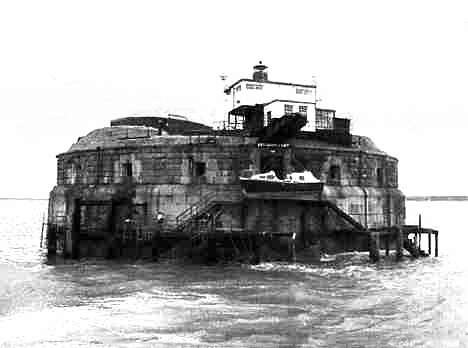

Spitbank (1861 - 1878) |
St Helens (1867-1880) |
Video Clip: Spitbank Fort
The Forts are big structures that need equally large investment the Solent's Forts have been preserved and are in corporate and private hands
Video Clip: Horse Sands the Solent

Nab
Tower (undated) |
Nab
Tower (1988) |
Trinity House took over running Nab Tower's powerful lights and fog horn in 1929 preventing shipping venturing towards Selsey Bill on the mainland or St Catherines Point on the Isle-of-Wight
In WWII manned by the Royal Navy Nab was fitted with a pair of Bofors Guns shooting down a number of enemy aircraft. The Navy left after the war the Nab remained MoD property
Unmanned since 1983 it was decommisioned by the MoD with Trinity House constructing a heli pad when acquiring freehold in 1984

Nab Tower (2013)
Due to extensive corrosion in 2013 the Tower was reduced in height from 27.4 to 17 m (90' to 55.7') all the outer steel removed and the concrete base structure sprayed with concrete
View Pathe Britain Clip 'Tower of the War' with one of the 'Mystery Towers' NAB Tower & Nab Tower 1954
Video Clip: Nab Tower
See the Nab Tower in Afloat and historic photographs in Solent
These substantial granite Forts are close to shore than the Thames Sea Forts and much easier to access
Following the Napoleonic design two further Forts of similar design were built in the Humber Estuary on Bull and Haile Sands. Construction began in May 1914 and completed in December 1919. They were manned again reactivated, modenised in WWII. Attacked many times in the conflict they had nets slung between them across the estuary to prevent enemy submarines reaching Hull and Grimsby


Bull Sand Fort |
Haile Sands Fort |
Video Clip: Haile Sands Fort
Video Clip: Bull Sands Fort
Abandoned in 1956 the smaller of the two Forts, Haile Sands is between Cleethorpes and Humberston. In 2017 it was reduced in price listed for sale at £3000,00. The four story Bull Sands 1.5 miles from Spurn Head and heavily armed to seaward, so both Forts are well within territorial limits and were precluded from Offshore Radio broadcasting
Bull Sands has grade II listed status and is owned by Streetwise Charitable Trust who intend using it as a drug rehabilitation centre


Gunfleet Lighthouse off the Essex coast
The last marine structure worth mentioning is the old Gunfleet Lighthouse situated 5 nautical (5.75) miles off Frinton-on-Sea at 51.46'.45" North 1.21'.27" East
Constructed in 1850 by James Walker of Trinity House it's one of several East Coast Screw Pile Light Houses, with seven piles screwed into the seabed joined by steel latice work
74 feet (23 metres) to it's top, originally painted red it's at the Northern end of the Gunfleet Sands marking the NE limit of the Port of London, deactivated and abandoned in 1921
Some 53 years later a crew from Radio Atlantis including Andy Anderson (Andy Gemmel-Smith 'Alice Broadcast') boarded the small tower
The Belgium offshore station had been forced to close with ratification of the Dutch Marine Offences Act on 1st September 1974
Work fitting windows, replacing the roof, long stripped of lead. Reinforcing floors, making rooms to take generators, transmitter and a studio was undertaken
On the strength that an American sourced Collins 10KW transmitter would be installed, Adriaan van Landschoot of the former Flemish station persuaded to invest
The Collins Auto Tune transmitter, in reality a 4KW four cabinet unit said to have had most of the wiring looms cut, cost around £5,000 may have come from Cole More Electronics in Southampton
The Atlantis team forged ahead with plans for a new station to be called Radio Dolphin due to launch on 244 metres on Christmas Day
There after several stories are voiced; One that on the 26th October 1974 the British Home Office swooped on the lighthouse & removed items, leaving notice of their visit to warn off trespassers. Secondly based on inside intelligence, the Royal Marine Commandos thwarted the operation with a raid in the early hours of 19th December 1974
Two occupants who'd arrived on a small boat earlier were put in a siege situation and ultimately forced to leave andthe equipment confiscated; Finally on the same day four Naval, Essex Police, Home Office and Trinity House vessels arrived at the lighthouse. Representatives from Trinity House inspected the structure, since they owned it. Subsequently the radio gear was dismantled, with the exception of the transmitter cabinet & those on board taken ashore but not prosecuted
Strangely the practicalities of operating a large enough generator to power a 10KW TX, erecting an antenna of sufficient height, and accommodate a minimal crew are questionable
Gunfleet Sands Windfarm 7km (8.05 Miles) off Clacton totals 48 turbines
A seabed structure rather than a Fort designed and built for 'Free' Radio TV broadcasting
Video Clip: Building the Dutch REM Island
See the Radio TV Noordzee Story

History of the Sea Forts Banner
07/02/08 - Up to joining Trinity House Lighthouse Service in
2005 I had been 26 years at a firm called Posford, Pavry & Partners, that
was John Posford's business earlier called Maunsell, Posford, Pavry &
Partners. The name change occurred when Guy Maunsell & John Posford decided
amicably to pursue separate paths. I always thought that John Posford was
a real "fine figure of a man" even at 70, merely the sight of the man, so
naturally straight, erect & square, shoulders back, chest thrust forward
could not fail to impress even before he spoke. His firm was a close family
in which everyone followed his lead playing their part. He never looked more
at home than in the official photographs taken as he was being introduced
to the Queen & speaking with her in the line of notables after she had
officially re-opened the famous cast iron & glass Palm House at the Royal
Botanical Gardens at Kew for which we, his firm, were the Consulting Engineers.
He was completely comfortable & natural in that position unlike so many
of other "lesser mortals". For many years of my time at "Posfords" I was Principal
Electrical Engineer in the Maritime Division of the firm, had so many smashing
colleagues & friends with achieved so many incredibly demanding things
around the British Isles & all over the world. The innovative passionate
engineering spirit of Guy Maunsell & John Posford did not retire or die
with them, they inspired so many young & not-so-young engineers who passed
on their knowledge to others. It was a way of life we know we did much good
work thanks partially to their inspiration. Those guys achievements were hard
to live up to, even when they had gone, but we enjoyed trying!
Sorry to have gone on a bit more than intended but I thought that you would
find the above of interest given how some of the vintage work of Guy Maunsell
& John Posford has impinged in your own life, their spirit is even now
alive & well at work in Peterborough & around the world. I have moved
to the Harwich area with Trinity House & on a clear day I can look out
over Dovercourt Bay aging "naked eyes" & see Rough's Tower (Sealand) on
the horizon & think "we" built that well over half a century ago, it has
seen a lot of life over the years & the North Sea still struggles to claim
it!
Keep up the good work, I will be back before long for more of those excellent
CDs Regards - Joe Tierney
04/04/15 - I would like to ask something about the Maunsell Fort sinking procedures. Did they prepare the seabed to be flat for the fort to rest onto? It seems weird to think that the seabed is entirely flat. Also was there any margin of error to where the fort actually landed when the sinking process began as opposed to where they would want it to land? - Lefteris Dousis
The sites were surveyed for flatness, remember they were mostly soft muddy sandbanks. Calm seas & weather were conditions was sought for grounding, then infill of around 500 tons of bit bats (brick rubble) & chalk deposited to slow erosion and under scouring. The Naval Towere weighed around 4.500 tons so found their own level settling evenly
The 580 ton Army Forts, straddled between two barges were winched individually to the sea bed, their 'Oxford Picture Frame' bases sank quickly into the mud, other Towers followed all linked by telescopic catwalks - Ed
For all the the Fort features navigate from ScrapBook Index
Visit the Offshore Shop for our range of Offshore Radio Fort Documentaries & the Sealand DVD
For pictures & the history Radio Atlantis & the Gunfleet Lighthouse
Download pdf Offshore Radio Antennas by Ian Anderson
Fishing Boat Registrations - Download : pdf or view : Website
During the summer months we run sailing trips from Whitstable & sometimes Herne Bay to see the imposing Thames Estuary Sea Forts see Boat Trips
References: Posford on the Construction of Britain's Sea Forts
Fort Fax logos by Jonathan S Farley and Barry Stewart, additional press cuttings Francois Lhote, Scott Mills